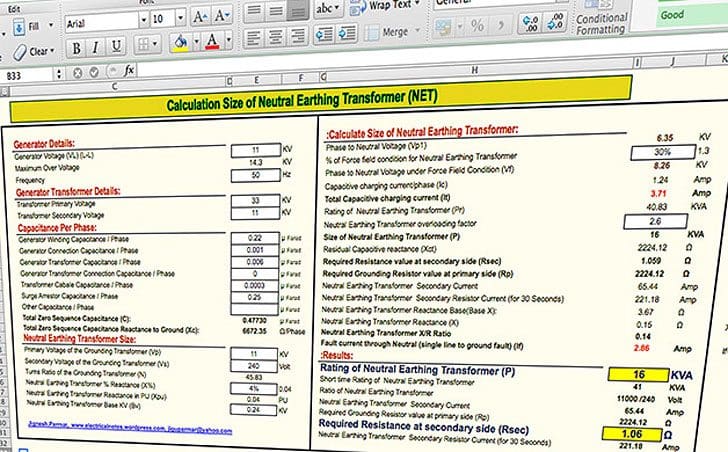
Transformer Design Calculation Excel
In this article you will learn how to calculate turns ratio of for high frequency switch mode power supply inverters. High ferrite core transformers are used in almost every power electronics circuits like.
They are used to boost up or step up low dc voltage of battery and other dc sources like solar panels. Ferrite core transformers are also used in isolated to step up or step down dc voltage.
One of the basic reasons for selecting three-phase is the transformer size. Another reason is, if dc is a requirement, the capacitor and inductor filtering components are both smaller. The odd shape of a three-phase transformer could be troublesome, as well as keeping balanced loads to minimize circulating currents. This edition introduces a complete electronic book on CD-ROM with over 100 live calculations–90% of the book’s calculations. Updated to reflect the new National Electric Code advances in transformer and motors; and the new system design and operating procedures in the electric utility industry prompted by deregulation.
For example in isolated it is used to step down dc voltage and in isolated, they are used to step up dc voltage. In this article, we will learn how to calculate turns ratio of high frequency ferrite core transformer with examples. Page Contents.Ferrite core turns ratio calculationFor example in boost up stage we have two options to use from power electronics converters, push pull topology and full bridge. I will explain both methods one by one. Turns ratio calculation formula and concept remains same for both topologies. The only difference between push pull topology and full bridge transformer design is that push pull ferrite corerequires a center tap in primary winding. In other words, push pull transformer have two times primary turn than full bridge transformer.
Fantasy Grounds' own online tutorials give step-by-step instructions on how to grab maps and art from Google Images and drop it directly into user-generated games.But Tito says players have been doing this sort of thing for generations, so why not support a tool that lets them do it easily?  Greg Tito, Wizard's communications manager, confirmed for Polygon that other campaigns, including and the recently released, are on the way for Fantasy Grounds.It's interesting that Wizards is partnering with a tool which, for all intents and purposes, allows users to scrape content off the internet for free and easily insert it into their games.
Push pull topology ferrite core turns ratio calculation with exampleLet’s start with example. For example we want to design a 250 watt boost up dc to dc converter. We are using push pull topology for this design.
We are using 12 volt battery. We want to step up dc voltage from 12 volt 310 volt. Switching frequency of design is 50KHz. We are using ETD39 ferrite core which can handle 250 watt. It is beyond the scope of this topic to tell how to select ferrite core according to power rating.
I will try to write separate article on it. The output of ferrite core will be always high frequency square wave of 50 KHz. We need to use full rectifier to convert it into dc of 310 volt. You may also need to use LC filter to harmonics or AC components from output. Ferrite Transformer Turns Calculation Ferrite transformer primary turns calculationAs you know battery voltage does not remain same all the time. As the load on battery on increases, battery voltage will be less than 12 volt. With no load with fully charged battery, battery voltage will be near to 13.5 volt.
Therefore input voltage is not constant, we must consider it while calculating turns ratio of ferrite core transformer. Cut off voltage for battery is usually 10.5 volt. We can take it as smallest possible value of input voltage to boost up dc converter. So we have following parameters now:Vinput = 10.5 voltVout = 310 voltAs we know that formula of turns ratio calculation in transformer isN = Npri / Nsc = Vin / VoutWhere Npri is number of primary turns and Nsc is number of secondary turns. We have three know variables like turns ratio which can be calculated by above equation, input voltage and output voltage.
But we need to calculate primary turns to find secondary turn of ferrite core transformer. Formula to calculate primary turns for ferrite core transformer is given below:Npri = Vin. 10^8 / 4. f. Bmax. AcBut for push pull it will be half the primary number of turns.
Where Npi is primary number of turn, Vin( nom) is normal input voltage which in our example is 10.5 volt. Bmax is maximum flux density. The unit of maximum flux density is Guass. Remember if you are using Tesla unit for maximum flux density, IT = 10^4 Guass. The value of maximum flux density is usually given in data sheet ferrite core. We usually take value of Bmax between 1300G to 2000G.
This is usually a acceptable range for all ferrite core transformers. Note: High value of flux density will saturate the core and low value of flux density will lead to core under utilization.
For example we will take 1500G for dc to dc converter example. f is switching frequency converter. In our example switching frequency of dc to dc converter is 50 KHz. Ac is effective cross sectional area of ferrite core.
We have to refer data sheet for this value. In this example, we are using ETD39 core. The effective cross sectional area of ETD39 is 125mm^2 or 1.25cm^2.We have all the values to calculate primary number of turns.i.e.Vin = 10.5 volt, Bmax = 1500G, f = 50 KHz, Ac = 1.25 cm^2By putting these parameters in two above formula, we can calculate turns primary number of turns.Npri = 12. 1.25 = 3.2Hence Npri = 3.2 But we cannot use fractional turns. So we need to round off primary turns calculated value into nearest whole number 3. The nearest possible whole number is 3. Primary number of turns for ferrite core is 3.
But before that we need check either for Npri = 3 Bmax is within acceptable range or not. As I have mentioned above the acceptable range for Bmaz is 1300-2000G. But the question is why we need to check the value of Bmax again? Because we adjust the value of primary turns from 3.2 to 3.
So let’s calculate value of Bmax for Npri = 3 by using above forumla.Bmax = Vin. 10^8 / 4.
f. Npri. AcBmax = 12. 10^8 / 5.
50000. 3. 1.25 = 1600GSo calculated value of Bmax is 1600G which is within acceptable range of maximum flux density.
Its mean we can take Npri = 3 for further calculations. Primary number of turns for push pull ferrite center tap transformer is 3 turns + 3 turns. In any design you will need to adjust the value of Npri if it is in fraction.
You can easily adjust it. But you need to check value of Bmax every time. We start with assume value of Bmax and calculated Npri. But you can also start with assume value of Npri and check the value of maximum flux density Bmax.
For example suppose a value of Npri =1 and check the value of Bmax and keep repeating this process, until it is become in acceptable range. Ferrite transformer secondary turns calculationNow let’s move to secondary turn of ferrite core. In our design the output of dc to dc converter is 310 volt at any input voltage. Input voltage is variable from 10.5 volt to 13.5 volt.
We will need to implementFeedback to get regulated 310 output voltage. So we will take little bit higher value of output voltage so that at minimum possible input we can still get output voltage of 310 volt by changing the duty cycle of PWM. So we should design a ferrite core transformer with secondary rated at 330 volt. Feedback will adjust the value of output voltage by changing the duty cycle of PWM.
You should also take care of losses and voltage drops across switching devices and you should take them into account while designing transformer.So transformer must be able to supply 330 volt output with input of 13.5 volt to 10.5 volt. The maximum duty cycle for PWM is 98% and rest 2% is left for dead time. During minimum possible input voltage duty cycle will be maximum. At maximum duty cycle of 98%, input voltage to transformer is 0.98. 10.5 = 10.29 volt.By using voltage ratio formula of transformer = voltage ratio = 330 / 10.29 = 32.1. Voltage ratio and turns ratio in transformer is equal to each other.
Hence N = 32.So we know all values to calculate secondary turns of ferrite core transformer.N = 32, Npri = 3Nsec = N. Npri = 32.3 = 96So number of primary turns is equal to 3 and number of secondary turns is equal to 96. So it is all about turns ratio calculation for high frequency transformers. If you have any issue, let me know with your comments. Post navigation. Hi Excellence,Since you have not provided all the values, let us assume Bmax = 1500 G, Switching Frequency f = 50KHz. Also Effective Area ( Ac ) of EE65 Ferrite core is 540mm^2 or 5.4cm^2 (As per datasheet ).
Now put the Vin value in this formula to calculate Npri:Npri = (Vin. 10^8) / (4. f. Bmax. Ac).After calculating Npri you may check Bmax value (if you wish).
Then follow those steps and use the formula I have mentioned above in my comment. And if you are facing problems, let me know with more details next time.
Have a nice day 🙂. Well, I am not professional in this either. Just leaning as you are. I can’t do practicals but can discuss and maybe sort out the problem. In this case I can’t find out because there can be many cases like:Case 1: Your input supply is is greater than 12VCase 2: Your switching frequency is lower than 50KHzCase 3: Core type is different.Please counter-check all these things. But unlike all these, Bmax seems ok to me. (You can assume minimum value i.e.
Bmax = 1300 too if you like)Considering Case 1 (which I don’t think should be greater than 12V in your case but let’s try): Let us assume your input supply is 20v. Keeping rest all values untouched.
After putting this value in the formula we get Npri = 1.2 1 Though this seems wrong to me but it is greater than 0.Consider Case 2: Lets us assume little more than minimum switching frequency i.e. F = 25Khz (just half of previous frequency).
So, Npri = 2.4 or 2 (after rounding off).Consider Case 3: If your core is different then the cross section area may also differ. It could be same too or maybe higher or smaller to 540mm^2.
Only in case when it is smaller can result to non-zero primary turns.Overall, it is important to check all those parameters I suppose because the formula is ok. Hope you find some practical help.