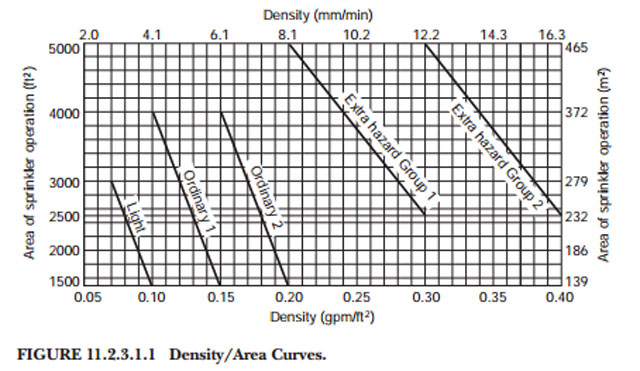
Sprinkler Design Density
Avid 7.0.3 crack. Minimum fire sprinkler design criteria february 16, 2007 3 e) Design calculations for inside pipe are to include C = 100 for dry pipe and preaction systems, C = 120 for wet and deluge systems. F) The maximum allowable water velocity in pipe shall not exceed 20 feet per second.
Hello Yassin, and welcome to the forum.Generally the NFPA 13 'K factor' for sprinklers is K=5.6. Generally sprinklers are 1/2' (DN15) connection size.The K factor is determined experimentally, but NFPA 13 currently mandates the use of a nominal K factor (e.g. 5.6) rather than the actual K factor. Makes things less confusing I think.It is used in the following formula:Q = K. (P)^0.5Q=gpm through the sprinklerP=pressure across the sprinklerNote: If you are already familiar with K factors, the NFPA 13 'K factor' is not to be confused with K factors used as loss coefficients in Darcy Weisbach based hydraulic calculations (fL/D). This one is wholly unique to sprinkler design.You can use sprinklers with K factors smaller than 5.6 but only in certain restricted instances (see NFPA 13). You can use K factors larger than 5.6 also, for example K=8.0 sprinklers are often used when a water supply is poor.I act as both the owner's agent and the AHJ, and often have sprinklers contractors say 'please issue a change order for a pump' when I already accepted the engineering design with a documented flow test, and they must think I am an idiot or a pushover one to let them get a fat change order.
I simply tell them to increase their pipe size and/or use K=8.0 heads. Problem solved.As for larger K factors, use them as necessary for the hazard involved, and install them within the limitations of their listing. K factors larger than 8.0 are only for specialized use like extended coverage (EC), CMSA, storage, and similar uses.Real world knowledge doesn't fall out of the sky on a parachute, but rather is gained in small increments during moments of panic or curiosity. RE: How can I choose the K-factor for sprinkler (Mechanical) 31 May 11 02:31. You can't use less than 5.6k for Ordinary hazard.
In light hazard, you can go down to 2.8k before you need to put a strainer on the line.In storage, you are typically going to start with a 8k sprinkler. If the density is 0.34, then you need a 11.2k sprinkler as a minimum.I use a lot of 4.2k sprinklers in wet attics. A max spacing of 130 sq ft in most attics. More realistic to be around 100 sq ft.
A 5.6k sprinkler will discharge about 15 gpm at 7 psi. A 4.2 is about 11.1 gpm at 7 psi. I can often save a pipe size or 2 with 4.2k sprinklers in the attics.It all comes from experience with calculations.Travis MackMFP Design, LLC.
No one wants a fire in their warehouse. Yet they happen every year. According to statistics from the (NFPA):. U.S. Fire departments respond to an estimated average of 1,210 fires in warehouses annually. These fires result in an annual average of $155 million in direct property damage, and the death or injury of 22 individuals. The leading causes of warehouse fires are arson or electrical.To support the development of better prevention measures, participates in the NFPA committee tasked with the creation and revision of national standards specific to the safe design of sprinkler systems.